

Hearing loss is very common, especially as we get older. In fact, many adults begin noticing trouble hearing conversations, needing the television louder, or struggling to hear clearly in noisy places.
Not all hearing loss is the same, though. There are three main types of hearing loss, and each type is treated differently. Understanding the difference can help you know what steps to take next.
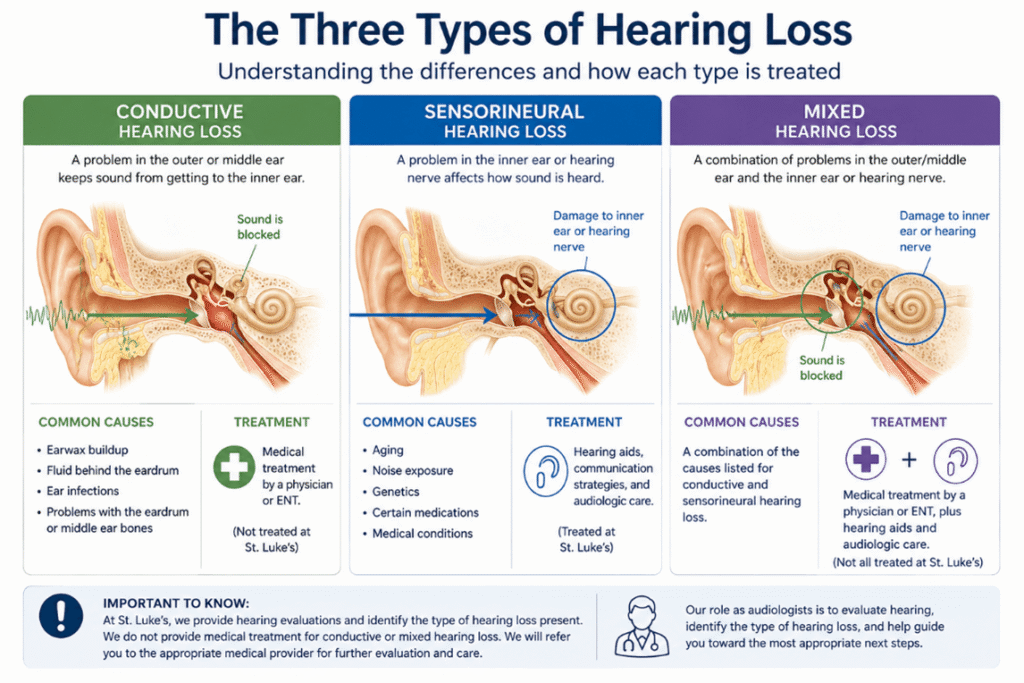
Conductive hearing loss happens when sound cannot travel properly through the outer or middle ear.
Common causes include:
People with conductive hearing loss often say sounds seem “muffled” or softer than normal.
Because conductive hearing loss is usually caused by a medical problem, treatment is often provided by a medical doctor or ENT (Ear, Nose, and Throat physician). Treatment may include:
At St. Luke’s, we provide hearing evaluations and identify the type of hearing loss present, but we do not provide medical treatment for conductive hearing loss. If testing suggests a conductive hearing loss, we will refer you to the appropriate medical provider for further evaluation and care.
Sensorineural hearing loss (sometimes called “nerve hearing loss”) is the most common type of hearing loss in adults.
It happens when there is damage to the inner ear or hearing nerve. Common causes include:
This type of hearing loss usually develops gradually over time.
People often notice:
Sensorineural hearing loss is usually treated with:
This is the type of hearing loss audiologists commonly help manage. At St. Luke’s, we evaluate hearing and help patients find hearing solutions that improve communication and quality of life.
Mixed hearing loss is a combination of both:
This means there is both a medical issue affecting sound transmission and inner ear hearing damage.
Treatment for mixed hearing loss often involves:
At St. Luke’s, we can identify mixed hearing loss during testing and guide patients toward the proper medical referral and then following medical clearance we will have the patient return to discuss hearing aid recommendations.
| Conductive | Sensorineural | Mixed | |
|---|---|---|---|
| Where the problem is | Outer or middle ear | Inner ear or auditory nerve | Both outer/middle AND inner ear |
| Common causes | Earwax, fluid, infection, eardrum damage | Aging, noise, illness, genetics | Combination of both types |
| Temporary or permanent? | Often temporary | Usually permanent | Varies by component |
| Common treatment path | Medication, procedures, or surgery | Hearing aids or other devices | Often both medical care and hearing technology |
You should schedule a hearing evaluation if you notice:
The earlier hearing loss is identified, the sooner treatment options can be discussed.
Hearing loss is not one-size-fits-all. Determining the type of hearing loss is one of the most important parts of a hearing evaluation because treatment depends on the cause. At St. Luke’s, our role as audiologists is to evaluate hearing, identify the type of hearing loss present, and help guide patients toward the most appropriate next steps. While we do not provide medical treatment for conductive or mixed hearing loss, we work closely with medical providers and ENTs when referral is needed.