LASIK (Laser-Assisted In Situ Keratomileusis) is a laser vision correction procedure that corrects refractive errors. These include nearsightedness, farsightedness, and astigmatism.
Refractive errors of the eye are caused by an irregular shaped cornea that prevents light from focusing directly on the retina, leading to blurry vision. LASIK eye surgery reshapes the cornea and corrects these refractive issues.
LASIK uses two lasers, an excimer laser, and a femtosecond laser. The femtosecond laser first creates a small flap in the cornea.
After making the flap, your surgeon will lift and expose the cornea tissue to correct it. Next, an excimer laser will be guided by a computer to remove a precise and predetermined amount of tissue from the cornea.
The flap is then laid down, where it acts as a natural bandage during recovery.
Although there is no denying that LASIK is a life-changing procedure, not everyone qualifies as a good candidate. Various factors go into your LASIK candidacy, like:
LASIK is only FDA-approved if you’re 18 or older. However St. Luke’s does not offer LASIK or PRK evaluations for individuals under the age of 21.
A crucial part of the LASIK candidacy process involves having a stable prescription. You may be a good LASIK candidate if your prescription has been stable for at least 2 years or more.
Potential LASIK candidates should not be pregnant, nursing, or planning on becoming pregnant within 6 months of the procedure. Getting LASIK often causes changes to your eyesight, making it less stable.
LASIK works because it involves reshaping the cornea and removing tissue to correct refractive errors. If you have a cornea that’s too thin, removing even a tiny amount of tissue from the cornea can cause serious complications.

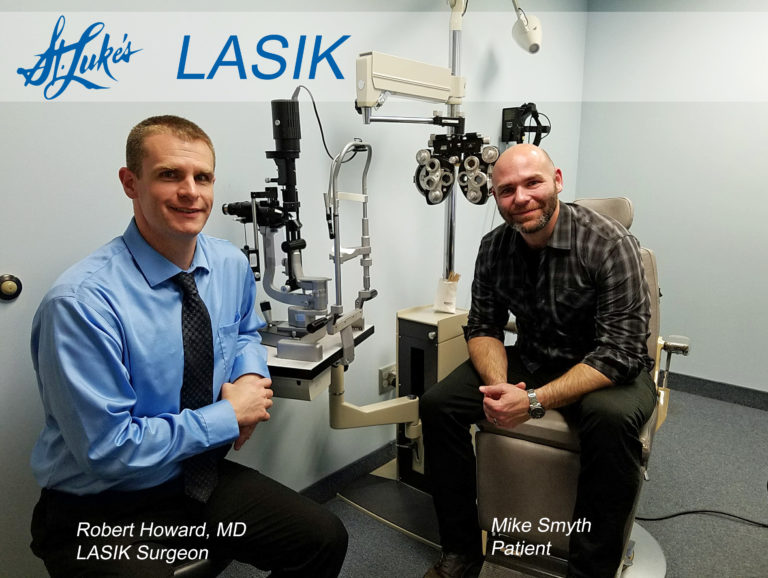
Robert Howard, MD, is a board-certified ophthalmologist specializing in LASIK surgery, medical ophthalmology and glaucoma care. He is a highly experienced LASIK surgeon, having performed countless refractive surgeries since starting his career in ophthalmology.
Before joining St. Luke’s, Dr. Robert Howard was with the U.S. Army for eight years, most recently as Chief of Ophthalmology at Fort Meade in Maryland. Prior to that he served as Chief of Ophthalmology and Refractive Surgery at Fort Riley, Kansas, and Co-Chief Resident at Brooke Army Medical Center in Texas. He began his career as an intern at William Beaumont Army Medical Center in Fort Bliss, Texas.
Dr. Howard completed his undergraduate studies in Economics at Middlebury College, Middlebury, Vermont, and received his medical degree from Tufts University School of Medicine in Boston, Massachusetts.
“I used to wear contact lenses and besides being a bit of a pain to wear, they sometimes caused me to have eye irritation & infections. I drive by St. Luke’s every day on my way to work so I decided to see if LASIK was an option for me. It was and I’m very pleased with my outcome. I had my procedure done in the morning and by dinner time, I already noticed a bit of an improvement. Later that evening, I watched a movie and that was when I really began to notice the clarity and sharpness of my vision. The procedure was even quicker than I’d imagined as was the recovery time.
Thanks to Dr. Howard and his team. I recommend him to anyone considering LASIK.”
Mike Smyth
New Port Richey, FL
Thanks to Dr. Howard and his team. I recommend him to anyone considering LASIK.
After having LASIK, go home and rest. As the numbing drops wear off, you may start experiencing discomfort such as a burning sensation, irritation, or grittiness.
These feelings should gradually improve on their own in the coming days after LASIK. Follow all instructions from your LASIK surgeon, including no eye makeup, keeping your eyes closed while showering or bathing, and no swimming for at least 2 weeks.
Your vision will improve in the days after LASIK, with most patients finding they can return to work the day after their procedure. Use all eye drops exactly as directed for the best results.
You’ll need to schedule follow-up appointments, including one for the day after your procedure, to check how your eyes are healing. Make sure to attend all scheduled follow-up appointments as necessary.
As your eyes heal in the weeks and months following LASIK, your vision will continue improving. Things will look sharper, clearer, and more detailed than ever before. You’ll be able to wake up and see without the need for corrective lenses.

Because LASIK is an elective medical procedure, we do not accept medical insurance. However, the cost of LASIK is easy to offset using financing plans.
At St. Luke’s, we offer financing with CareCredit, which allows you to pay for LASIK immediately and then pay for your procedure with affordable monthly payments for up to 12 months. This option ensures patients can fit LASIK into their budget and achieve their vision correction dreams. We also accept FSA (Flexible Spending Accounts) and HSA (Health Savings Accounts) towards procedures.
There’s no reason why cost should stand in the way of better vision!
Are you ready to find out if you could be a good LASIK or PRK candidate? Schedule your LASIK consultation at St. Luke’s Cataract & Laser Institute today!